
Generative AI And Data Management Use Cases For Various Industries
We stand at the genesis of a technological revolution powered by creative artificial intelligence. Dubbed generative AI, these trailblazing models can autonomously generate novel content, insights, and creations that are indistinguishable from human-crafted work.
Fuelled by neural networks and vast datasets, generative AI marks a radical shift - machines are no longer simply following programmed rules. Instead, they are adept at imagination, innovation, and inspiration that was once considered the sole domain of human originality. The applications of this emerging technology span industries and use cases.
Market Trends
Consumer enthusiasm for emergent generative models foreshadows immense market potential. ChatGPT and other viral sensations exhibited the transformative utility of this technology for the masses.
Industry reports validate this promising growth trajectory. Generative AI is forecasted to balloon from a $40 billion market valuation in 2022 to over $1.3 trillion by 2032, representing a prolific 42% compound annual growth rate (CAGR) over the next decade.
What's propelling this breakneck expansion?
For starters, generative AI unlocks new revenue streams for software and services. By one projection, it could additionally rake in $280 billion in consumer and enterprise software revenue. These specialized tools increase productivity, automate workflows, and enhance customer experiences.
Industry reports validate this promising growth trajectory. Generative AI is forecasted to balloon from a $40 billion market valuation in 2022 to over $1.3 trillion by 2032, representing a prolific 42% compound annual growth rate (CAGR) over the next decade.
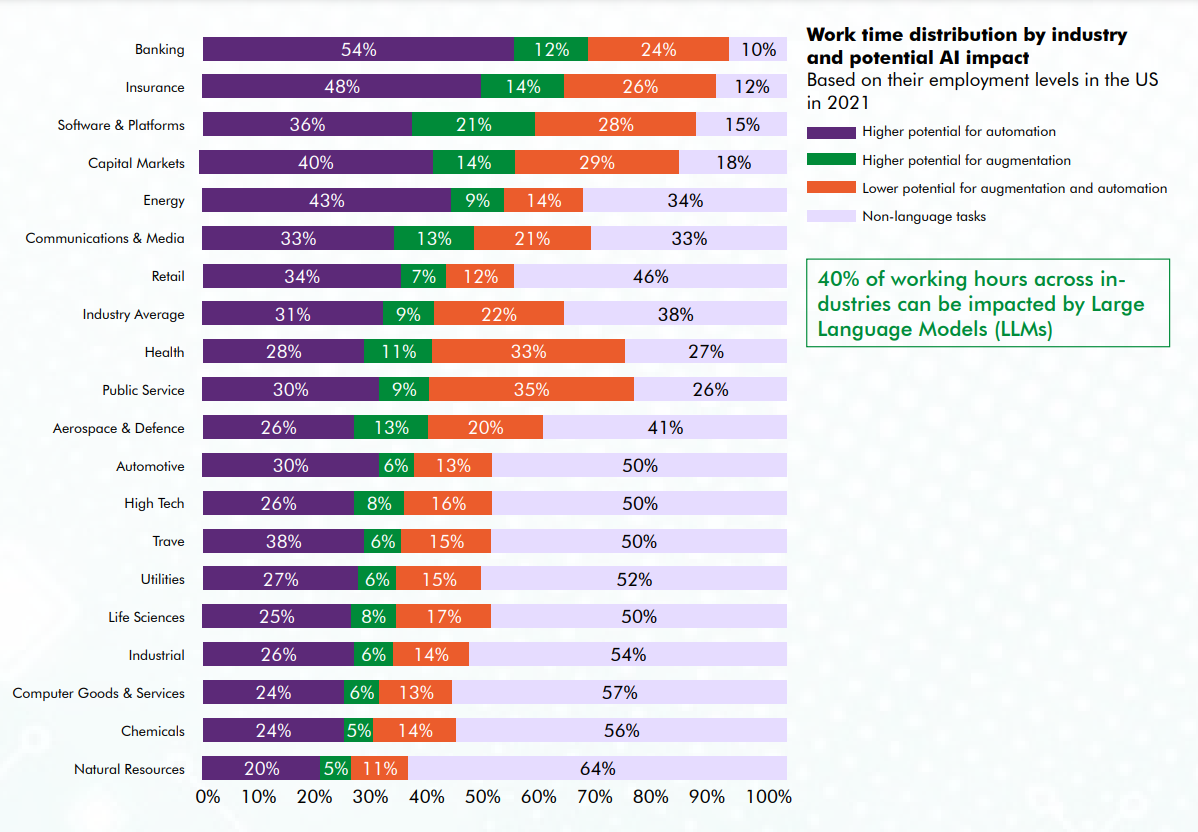
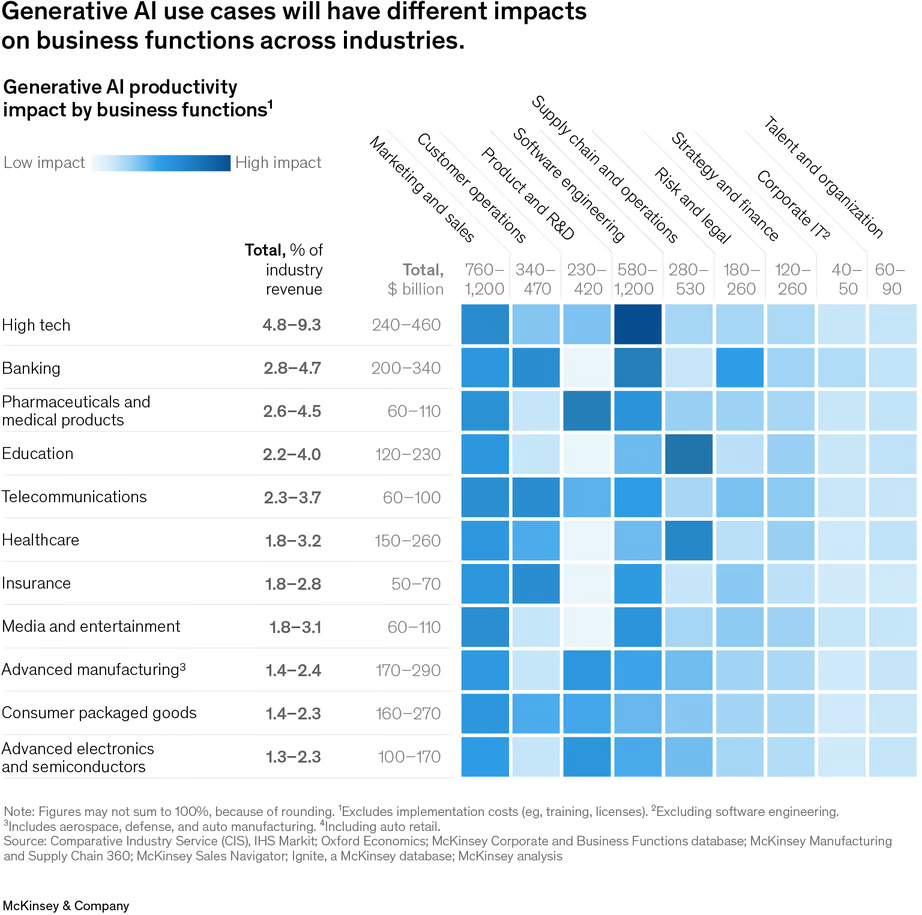
Impact of Generative AI
Source File: Indiaai.s3.ap-south-1.amazonaws.com/docs/generative-ai-report.pdf
Source: McKinsey. (2023). The economic potential of generative AI: The next productivity frontier.
Retrieved from :
Mckinsey.com/capabilities/mckinsey-digital/our-insights/the-economic-potential-of-generative-ai-the-next-productivity-frontier#industry-impacts
Benefits of Generative AI
- Data Democratization: Generative AI simplifies the complex; it democratizes the data within your organization. It allows non-technical users to access and interpret data, reducing the dependence on data scientists. This empowers employees at all levels to make data-driven decisions, fostering a more agile and informed workforce.
- Resolve Blind Spots: Generative AI has the capability to identify and resolve blind spots in your data. By automatically identifying anomalies, trends, or hidden patterns, it helps you uncover critical insights that may have gone unnoticed in traditional data analysis methods.
- Query Unstructured Data: Traditional tools struggle with unstructured data. Generative AI, on the other hand, excels in handling unstructured data, making it possible to extract valuable information from sources that were previously untapped. This capability broadens the scope of data analytics, allowing businesses to gain insights from diverse data types.
- Real-Time Analytics: Generative AI enables real-time analytics, which is essential in today's fast-paced business environment. It can process and analyze data as it flows in, providing up-to-the-minute insights. This real-time capability is invaluable for making on-the-spot decisions, especially in industries like e-commerce, finance, and healthcare.
- Operational Efficiency: By automating data analytics processes, Generative AI can significantly reduce the time and resources required for data analysis. This translates into cost reduction and allows your team to focus on more strategic tasks.
- Sustained Competitiveness: By harnessing the power of Generative AI in data analytics, your organization gains a competitive advantage. It enables you to adapt to changing market conditions, anticipate trends, and stay ahead of the competition.
Business Use Cases
1. Document Analysis and Summarization:
Industries faces the challenge of summarizing lengthy documents, such as contracts or policies documents, which often requires high manual effort. Summarizing documents by humans
can introduce issues which may arise due to subjectivity, potential biases, misinterpretation of complex language, and the risk of errors, impacting the accuracy and completeness of the summary.
SCIKIQ’s Gen AI capability analyses and summarizes lengthy documents. This can save organization valuable time and help them extract key information efficiently and error free.
2. Research and Knowledge Management:
Tasks such as searching critical information through documents consumes significant efforts which relies on human reviews leading to oversights and errors.
Organizations require an
efficient and accurate solution to manage and extract useful data from the vast knowledge base.
SCIKIQ’s Generative AI can speed up research by quickly searching and analysing relevant documents enabling employees to access information with ease.
3. Human Resource: Resume Screening:
Traditional resume screening can be a time-consuming and daunting task, often leading to overlooked potential candidates or mismatches in job requirements.
SCIKIQ's Generative AI brings efficiency and precision to your hiring process. By leveraging advanced algorithms, our AI analyzes resumes and job descriptions
with unparalleled accuracy, ensuring a seamless match between candidates and job requirements. This integration streamlines the initial screening phase, saving
valuable time for your HR team and allowing them to focus on more strategic aspects of the hiring process.
4. Customer Service: Email and Support:
We're all familiar with the frustrating challenges that crop up when we need assistance. It can be a real hassle to wait on hold for ages, get conflicting answers, and struggle to find immediate help.
These everyday annoyances leave customers feeling dissatisfied, and the hardworking support teams are stretched thin.
With SCIKIQ’s Generative AI integrated in your organization, whenever customers have questions about policy, or just a general question, our AI-powered virtual assistant is here to help them in real-time. Not only it makes their interactions smoother and more enjoyable, but it also takes some of the pressure off your hardworking support teams.
5. Literacy and Education Chatbots:
In today's landscape, organizations struggle to educate customers about their services, leading to confusion due to information overload. This calls for a user-friendly,
on-demand financial information system, enabling customers to make informed decisions independently and avoid decision paralysis.
SCIKIQ’s Generative AI-powered bots can be used to educate customers about various products and topcis. These chatbots provide explanations of banking products and services and offer personalized financial tips. Topic analysis capabilities can be used to identify knowledge gaps and tailor content to individual customer needs. For example, the chatbot could summarize key concepts in areas like budgeting, saving, and investing, helping customers make better financial decision.
Generative AI Use Cases
| Use Cases | Examples | Pain Points | Impact/Benefits | Industry |
|---|
| Provide Information, Classify, route customer queries to after identifying intent. | QnA Chatbots, Ticketing chatbots. |
1. Providing 24/7 customer service with human agents is expensive. 2. Customers frustrated by repetitive and scripted conversational experiences. 3. Difficult for businesses to scale messaging across global audiences. |
1. Streamlines Complex workflows. 2. Reduction in operational costs. 3. Improve NPS and customer satisfaction./p> 4. 24x7 service. 5. Reduce ticket time by 99%. 6. Reduces the need for point. |
Valid for All |
| Analyze customer feedback, reviews, support tickets to understand sentiment and identify pain points. Helps improve products/services. | BFSI, Ecommerce product reviews, Playstore reviews which could be in thousands can be analyzed to identify customers sentiments towards the product. |
1. Difficulty understanding true sentiment in large volumes of unstructured customer feedback data. 2. Time consuming to manually review and tag customer sentiment across channels. 3. Inability to track sentiment changes over time or by audience. |
1. Improve NPS 2. Improvement in Product and Services |
Valid for All |
| Organize company knowledge bases and answer employee questions by analyzing text sources. | Legal knowledge management, banking product portfolio management. |
1. Knowledge is siloed across the organization in document repositories and individual experts. 2. Employees waste time searching for or recreating existing company knowledge. 3. High dependency on tribal knowledge that is lost when employees leave. |
1. Reduction in manual effort by 90%. 2. Accurate search with references to specific page. 3. No missing out on details. |
Legal, BFSI, HR, Education, IT, Journalism |
| Automatically generate summaries of text documents to extract key information. Classifying them into buckets of information. |
Fashion industry can classify customer comments into color, collection, style trends.
Medical reports can be summarized automatically based on the threshold criteria, providing a better understanding of the result to the patients. |
1. Tedious and time consuming for employees to review and extract key points from lengthy documents. 2. Difficult to identify relevant content and insights quickly from large document collections. 3. Meetings and decisions delayed by inability to digest information rapidly. |
1. Reduces manual effort. 2. Accurately classifies large chunks of information. 3. Improve the customer experience. |
Valid for All |
| Automatically classify, extract key information from, route, and file documents like contracts, invoices, etc. | Claim processing for insurance can be streamlined with the integration of OCR(optional), Generative AI and RPA. |
1. Reliance on error-prone optical character recognition for ingesting document data. 2. Unstructured data in documents can't be used for reporting and analytics. 3. Difficult to sort, categorize, route high volumes of incoming documents. |
1. Reduction in AHT. 2. Accurate processing. 3. Reduction in attrition (as company faces significant attrition due to reduntant tasks being performed by the operations team). |
Valid for all -> Finance department |
| Auto complete texts, Useful in drafting emails based on the SOP manual. | Ex. Google Auto Complete in the search bar, and in the emails, with integration with SOPs and manuals for customer service. |
1. Writing content, emails, support articles requires significant time investment. 2. Lack of resources to produce high volumes of customized textual content. 3. Dependence on few expert copywriters to relay messaging. |
1. Reduces manual effort by the employees. 2. Faster processing. |
Customer Service Department |
| Automatically hides confidential data, and provides the documents. | Medical and Pyschiatric reports, financial reports redaction of confidential details. |
1. Risk of sensitive data exposure when sharing documents containing private content. 2. Manual redaction of protected information is prone to human error. 3. Scaling redaction across large document sets requires very labor intensive review. |
1. Data security. 2. Reduction in legal troubles. 3. Reduction in legal troubles. |
Medical, Legal, Banking, Finance |
| Gen AI can identify where the changes are made, it is often difficult to keep track of the changes and companies use multiple tools, and it is still often hard to track. | Highlight major changes, raises flags, holds accountable. |
1. Hard to manually identify and track changes across multiple versions of documents. 2. Risk of missing critical document edits during review process. 3. Weak audit trail of who changed what and when. |
1. Better tracking. 2. Improvement in Accountabiliy. 3. Improve collaboration. |
Legal, Education |
| Customers struggles to find relevant products and services, leading them even more confused, knowledge can be provided through intelligent agents. | Knowledge can be provided about financial products and services, such as mutual funds, stocks etc. |
1. Connecting employees with the right expert or knowledge source is unpredictable. 2. Duplicating efforts because existing knowledge isn't discoverable. 3. Best practices and expertise not captured and retained over time. |
1. Improves Top Line. 2. Reduction of work from sales employee. 3. Relevant Product discovery. 4. Improve faith in the suggestions (Customers often feel tricked by the salesmen). |
Valid for All |
| It can identify relationships between different data points and create enriched customer profiles. This enables sales, marketing, and customer service teams to have a deep understanding of each customer’s preferences, behaviors, and needs. | Comprehensive 360 view of the Customer information to the industry. |
1. Deriving insights from data requires manual analysis and data science skills. 2. Time lag between raw data and actionable business insights and recommendations. 3. Lack of capability to answer ad hoc business questions with data. |
1. Improvement in targetting and campaigns. 2. Improvement in products and services. |
Valid for All |
How SCIKIQ uses Generative AI
SCIKIQ uses state-of-the-art LLM designed to help our clients improve their processes, just like having a tech-savvy personal librarian at your service.
Our Generative AI solution works seamlessly to locate the information you need. It scans the entire knowledge base, picking out the most relevant topics buried within lengthy documents and providing you with concise summaries. It's like having your very own research assistant.
SCIKIQ understands plain English, it delves deep into unstructured data to uncover most relevant answers. Furthermore, it seamlessly integrates with chatbots, enabling the creation of intelligent solutions.
What sets SCIKIQ apart is its ability to safeguard your data's confidentiality and its offline functionality. This makes it the ideal choice for enterprises that require instant information access, even in offline settings, while ensuring the utmost privacy and security of their valuable data.
The Future for Generative AI
We stand at the genesis of a new era - one fuelled by exponential advances in generative artificial intelligence. As these creative algorithms continue maturing, their extraordinary potential will reshape industries and revolutionize how we live and work.
Looking ahead, experts forecast generative AI catalysing breakthroughs across sectors - from personalized healthcare to smart sustainable cities and beyond. Its possibilities span as wide as imagination itself.